
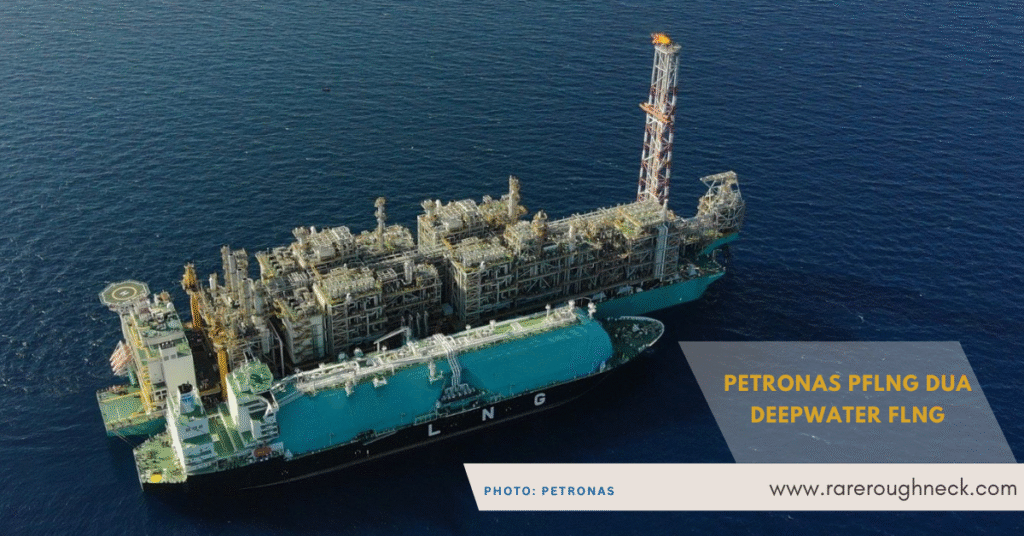
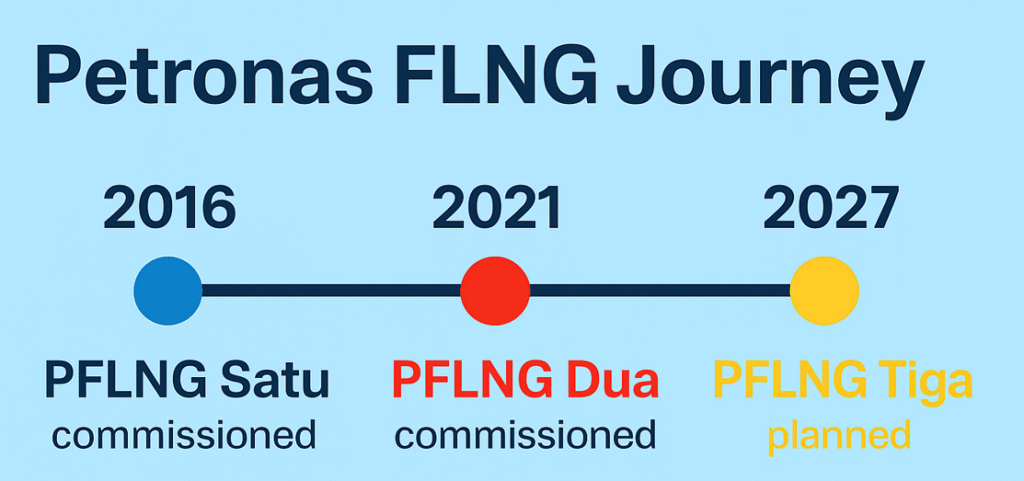
Malaysia is no stranger to LNG innovation. After making history with PFLNG Satu in 2016, Petronas doubled down on its ambitions with PFLNG Dua, the world’s first deepwater floating LNG facility, stationed offshore Sabah at the Rotan gas field.
At a time when the LNG industry is dominated by massive onshore projects, Petronas has proven that floating LNG—particularly in ultra-deepwater (1,300m)—is not just possible, but also commercially viable.
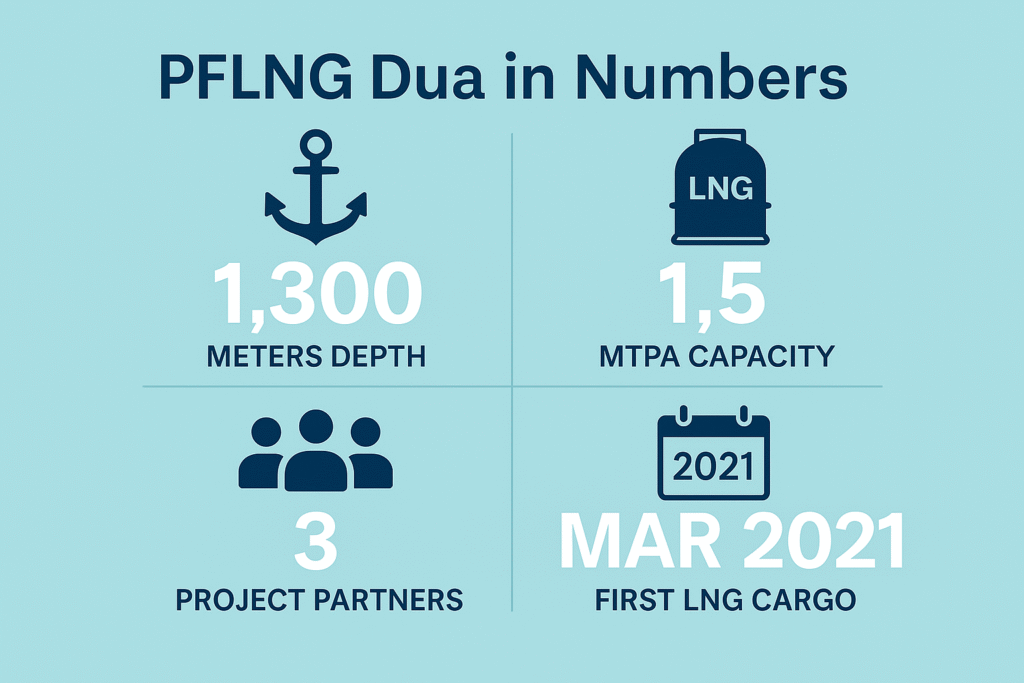
PFLNG Dua in Numbers
Let’s break down what makes Petronas PFLNG Dua Deepwater FLNG such a game changer:
- Operator: Petronas
- Location: Rotan Gas Field, offshore Sabah, Malaysia
- Water Depth: 1,300m (world’s first deepwater FLNG)
- Capacity: 1.5 million tonnes of LNG per annum (Mtpa)
- Commissioned: 2021
- Partners: JGC Corporation (Japan) + Samsung Heavy Industries (Korea)
- Cargoes Delivered: First LNG cargo exported March 2021
Engineering & Technology Marvel
Unlike Shell’s Prelude FLNG in Australia (shallower waters), PFLNG Dua is purpose-built for ultra-deepwater operations.
Key innovations:
- Subsea Systems: Gas extracted directly from seabed reservoirs.
- Liquefaction Technology: Compact modular design enabling LNG production onboard.
- Amine Gas Treatment (OASE® purple): World’s first FLNG to use this low-energy solvent, reducing operational costs and CO₂ emissions.
- Offloading System: LNG transferred directly to carriers at sea, without the need for costly pipelines.
Achievements of Petronas PFLNG Dua
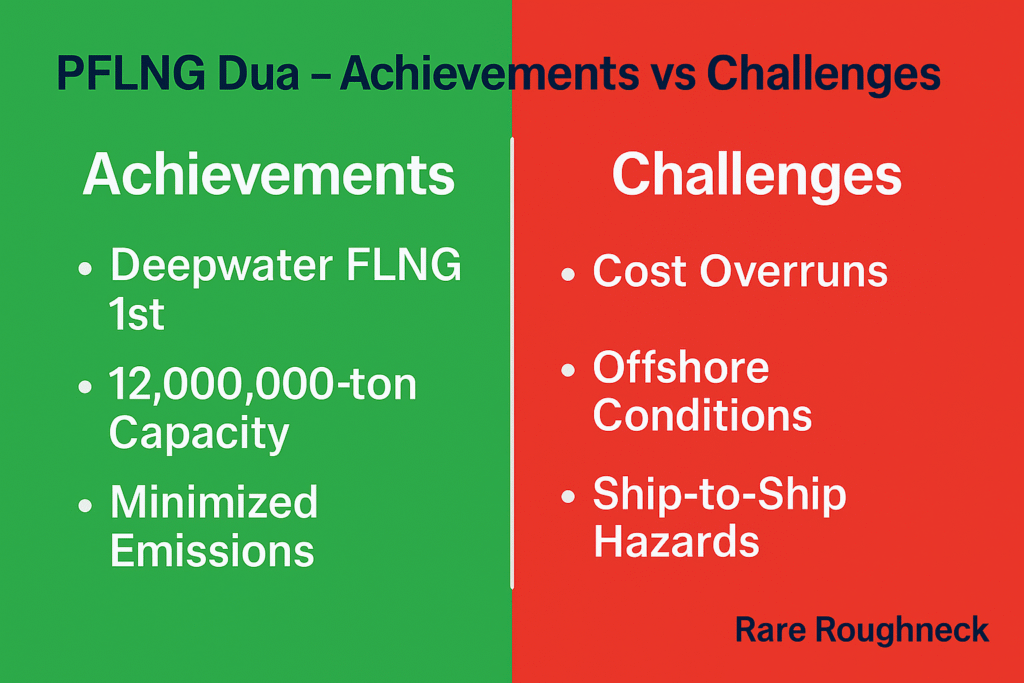
- World’s First Deepwater FLNG: A technological milestone in offshore LNG.
- Malaysia: Global FLNG Pioneer: First company in the world to operate two FLNG facilities (PFLNG Satu + Dua).
- Rapid Commissioning: From first gas (Feb 2021) to first commercial LNG cargo (March 2021) in just over a month.
- Sustainability Milestone: Achieved 80% reduction in flaring and cut 135,000 tonnes of CO₂ emissions between 2021–2022.
- Market Impact: Strengthened Petronas’ supply portfolio to Japan, Korea, China, and the wider Asia-Pacific.
Challenges of PFLNG Dua
- Technical Complexity: Deepwater mooring and subsea tie-ins require precision engineering.
- Operational Risks: Offshore LNG production exposes facilities to storms and maintenance difficulties.
- High Costs: Estimated multi-billion dollar investment, requiring long-term market stability.
- Global Competition: Onshore mega-projects in Qatar and Australia still dominate in volume.
Strategic Significance for Malaysia
PFLNG Dua doesn’t just add LNG capacity—it symbolizes Malaysia’s energy leadership. By deploying deepwater FLNG technology, Petronas has:
- Unlocked smaller, remote fields like Rotan.
- Reduced reliance on costly pipelines and land-based infrastructure.
- Strengthened its competitive edge as global LNG demand surges.
Future Outlook
With PFLNG Dua operational, and PFLNG Tiga (nearshore) planned for 2027, Petronas is shaping the future of LNG flexibility. While challenges remain, deepwater FLNG is no longer theory—it’s proven reality.
Conclusion
Petronas PFLNG Dua Deepwater FLNG is more than a floating facility—it’s a statement of ambition. By pioneering deepwater LNG production, Petronas has positioned Malaysia as a true innovator in the global energy landscape.

