
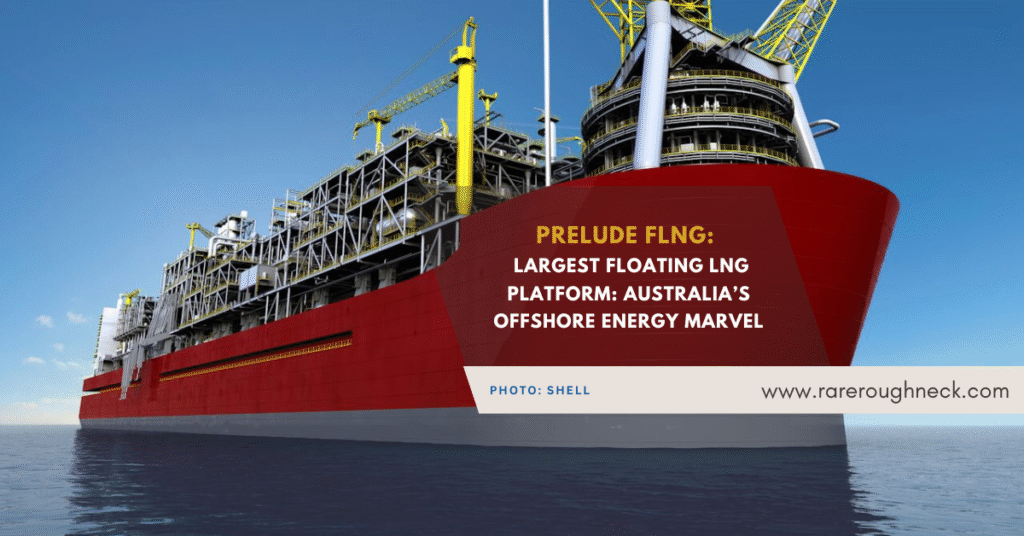
Prelude FLNG largest floating LNG platform is not just an engineering project—it is a floating city at sea. At 488 meters long and 74 meters wide, it is longer than four football fields and taller than the Eiffel Tower when measured end to end. Stationed in Australia’s Browse Basin, 475 km off Western Australia’s coast, Prelude is designed to produce, liquefy, store, and transfer natural gas without a single pipeline to shore.
Imagine the Eiffel Tower, Sydney Opera House, and London’s Big Ben lined up together—and Prelude still dwarfs them in scale. It’s a marvel of modern engineering that redefines how energy companies think about offshore gas.
Read our detailed guide on Floating LNG to understand the technology that made Prelude FLNG possible
Floating LNG 2025: The Future of Offshore Gas Production
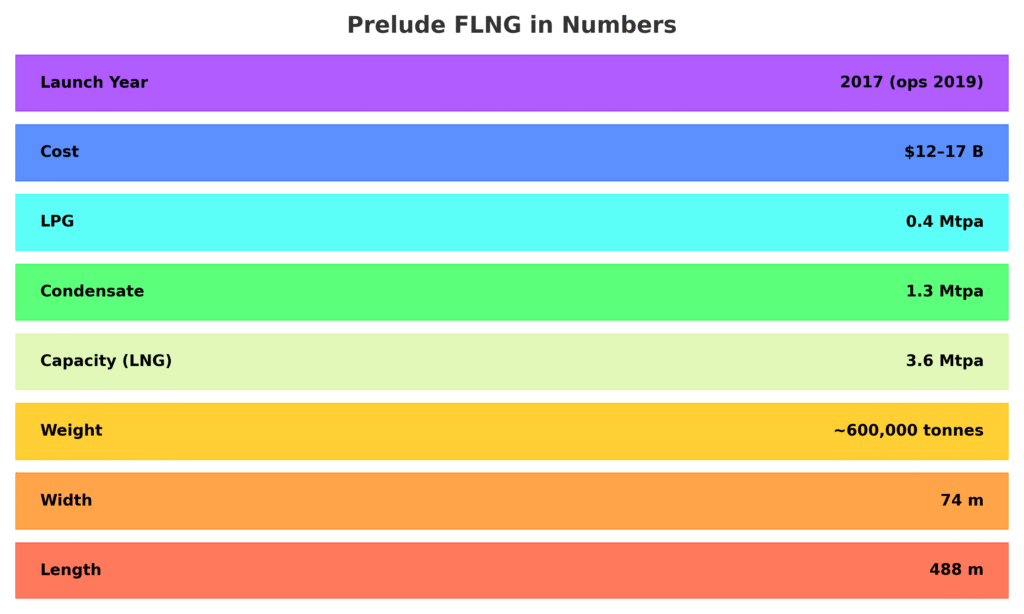
Prelude FLNG Largest Floating LNG Platform – At a Glance
- Operator: Shell (with partners INPEX, KOGAS, CPC)
- Location: Browse Basin, Western Australia
- Length: 488m | Width: 74m | Weight: ~600,000 tonnes
- Capacity: 3.6 Mtpa LNG, 1.3 Mtpa condensate, 0.4 Mtpa LPG
- Cost: Estimated $12–17 billion
- Launch: Built in South Korea (Technip–Samsung consortium), towed to Australia in 2017, operational since 2019
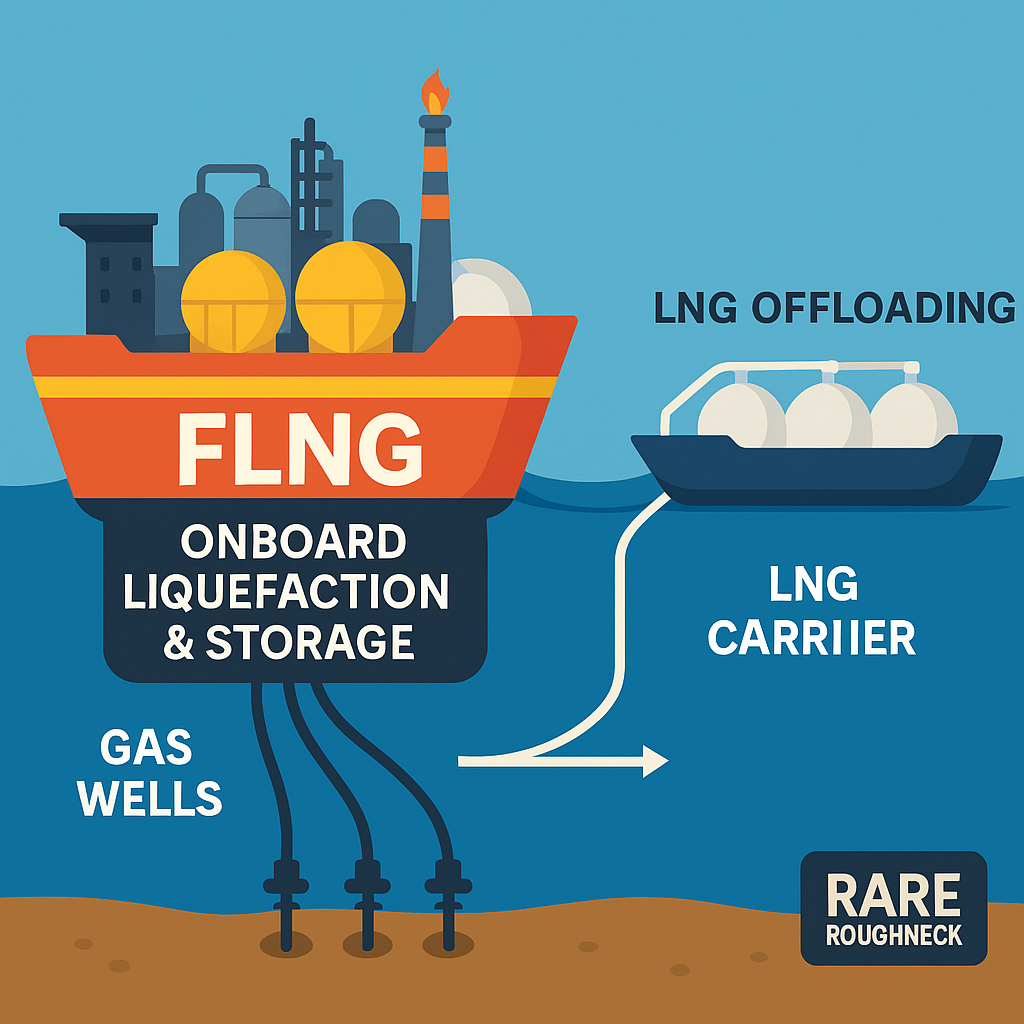
How Prelude FLNG Works
Prelude FLNG functions as a self-contained LNG plant at sea, performing every step of the LNG value chain onboard:
- Gas Extraction – Subsea wells pump natural gas to the facility.
- Processing – CO₂, water, and impurities are removed.
- Liquefaction – Gas cooled to −162°C, reducing its volume 600x.
- Storage – Liquefied gas stored in hull tanks.
- Offloading – LNG carriers dock alongside to load and transport.
Instead of building expensive pipelines and onshore terminals, Prelude achieves everything offshore—making it a game-changer in LNG development.
Prelude FLNG Compared to Global Icons
Prelude is not only the largest floating LNG platform—it’s one of the largest structures ever built by humans.
- 488m long → longer than four football fields
- Longer than the Eiffel Tower (324m) laid flat
- Bigger footprint than Sydney Opera House and Petronas Towers combined
- Taller than Tokyo Sky Tree (634m) if stood vertically
Shell often describes it as a structure that could “envelop the Statue of Liberty or swallow the Eiffel Tower.”
Why Shell Built Prelude FLNG Largest Floating LNG Platform
Shell’s decision to build Prelude was not just about breaking records. According to KPMG’s FLNG analysis, companies turn to floating LNG for strategic reasons:
- Unlock remote gas fields that would otherwise be stranded
- Avoid costly pipelines hundreds of kilometers to shore
- Reduce environmental footprint compared to land terminals
- Build in controlled shipyards, avoiding high Australian construction costs
- Provide flexibility—in theory, an FLNG can relocate if needed
For Shell, Prelude was a bold solution to unlock Australia’s offshore reserves while showcasing the future of LNG.
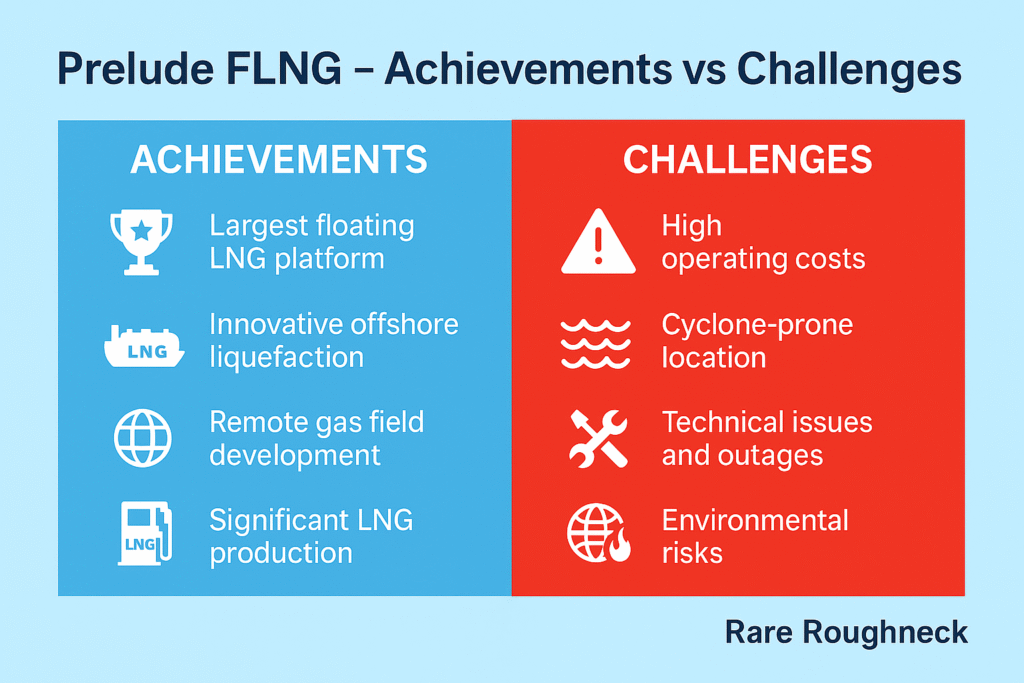
Challenges for Prelude FLNG Largest Floating LNG Platform
But being first of its kind comes with setbacks:
- Cost Overruns – Originally $12 billion, final costs closer to $17–18 billion.
- Global Supply Chain – Hull built in Korea, turret in Dubai, subsea kit in Malaysia, systems in Singapore—coordination was a nightmare.
- Operational Risks – Prelude faced fires, blackouts, and cyclone disruptions, leading to multiple shutdowns.
- Maintenance at Sea – Repairs offshore are slower, more expensive, and risky compared to land.
Despite challenges, Prelude continues to operate as a pioneer FLNG model, offering lessons for the next wave of projects.
Prelude’s Role in the Global LNG Market
- Adds 3.6 Mtpa LNG capacity, enough to power millions of homes.
- Supplies LNG mainly to Asia-Pacific buyers—Japan, Korea, and China.
- Acts as the pathfinder for FLNG projects worldwide—inspiring Malaysia’s Petronas PFLNG Dua and Mozambique’s Coral-Sul FLNG.
- Symbolizes LNG industry’s shift to flexibility and innovation.
The Future of Floating LNG
Prelude FLNG’s future will decide how far FLNG can go. If it overcomes challenges and achieves consistent production, expect many more FLNG units in Africa, Asia, and South America.
If not, the industry may remain cautious. But either way, Prelude FLNG largest floating LNG platform has already secured its place in offshore energy history
Resources
Conclusion
Prelude is more than a ship—it’s a floating energy revolution. By combining innovation, scale, and bold ambition, Shell created the largest floating LNG platform ever built.
It may face storms, technical issues, and criticism, but it remains the benchmark for the FLNG era.
For the LNG world, Prelude is both a lesson and a landmark—proof of what’s possible when engineering dares to dream bigger than the sea itself.


Pingback: Floating LNG 2025: The Future of Offshore Gas Production
Pingback: Petronas PFLNG Dua Deepwater FLNG: Malaysia’s Offshore LNG Innovation